Make Your People Your Product

Many technical and product-driven founders (especially engineers) have a weird blind spot. While they can build and instrument the hell out of their product, they strangely tend to manage their people with vibes, casual checkins and gut feel.

If you’re a product person or an engineer moving into leadership, here’s a framing that makes it much more clear how you should manage and how to be successful at it.

Your team is now your product.

I don’t mean this as a metaphor but as a management strategy.

I was talking with a CEO about one of his engineering leaders who is smart, capable, good intentions but hit that classic wall. He was saying…

  • “I don’t know if I should be Director of Engineering.”
  • “Two people are frustrated and I feel like I’m failing.”
  • “I just want to go back to coding.”

I gave him the same advice I got from my manager at Airbnb when I was put in charge of managing 8 PMs. It was to stop thinking about “managing people” and keep thinking like a product builder.

Why this works

We all have experience with

  • Systems
  • Feedback loops
  • Metrics
  • Experiments
  • Iteration
  • Clear definitions of “working” vs “not working”

This is easy with products. But people are messy. Why not treat people like products? Meaning

Design → Instrument → Observe → Iterate.

What that means, practically

If your team is the product, you naturally start asking better questions:

1) What does “great” look like?

A product team starts with a spec.

So does a leader.

  • What kind of team are we trying to build?
  • What behaviors do we want?
  • What’s our bar for talent and attitude?
  • What do we tolerate? What do we not tolerate?

This is where a lot of leaders accidentally fall flat. They treat team shape as something that “happens” to them; they accept what was already there.

2) What are the core metrics?

Product builders track usage, retention, satisfaction, conversion.

For teams, the equivalent categories are similar:

  • Satisfaction: Do people actually like working here?
  • Adoption: Are they bought into the direction, the standards, the operating cadence?
  • Effectiveness: Are we shipping? Are we solving real problems and moving metrics? Are we getting better?
  • Energy: Do people come in hot… or dragged? Yes, “energy” is a metric. It’s just one you measure with eyes and ears instead of Mixpanel.

3) How do we instrument it?

Product people and Engineers will track everything. But often are have no idea what’s happening inside their team. You can instrument the human system:

  • Regular check-ins that aren’t just status updates
  • 1:1s that include “what’s working / what’s not”
  • Clear expectations in writing
  • Visible goals and ownership
  • Team health pulse (simple, repeatable)

Not because you want bureaucracy or to be a micro-manager, but think of it as data or signal.

4) What experiments are we running?

To improve a product you run experiments. Same with teams.

Examples:

  • Try a new meeting cadence for 2 weeks
  • Change how decisions are made (who decides what)
  • Redefine roles or ownership boundaries
  • Adjust hiring bar and interview loop
  • Coach hard, or cut fast—based on data and standards

Iteration is not a bad thing. If you’re not learning, you’re not doing enough.

Gut-check Questions

If you’re leading people, ask yourself:

  • Do I have a clear picture of the team I’m building?
  • Do I know how I’ll notice if it’s working?
  • Do I have a feedback loop that gives me signal early?
  • Am I running experiments, or just reacting?

If the answers are fuzzy, you don’t have a “people problem.” You have a product management problem. Or, even harsher, YOU are the problem.

Make your people your product.
Design it. Measure it. Iterate it. Ship a better version every month.

Because in the end, your code isn’t your company. Your team is.
3-Step Process to Success

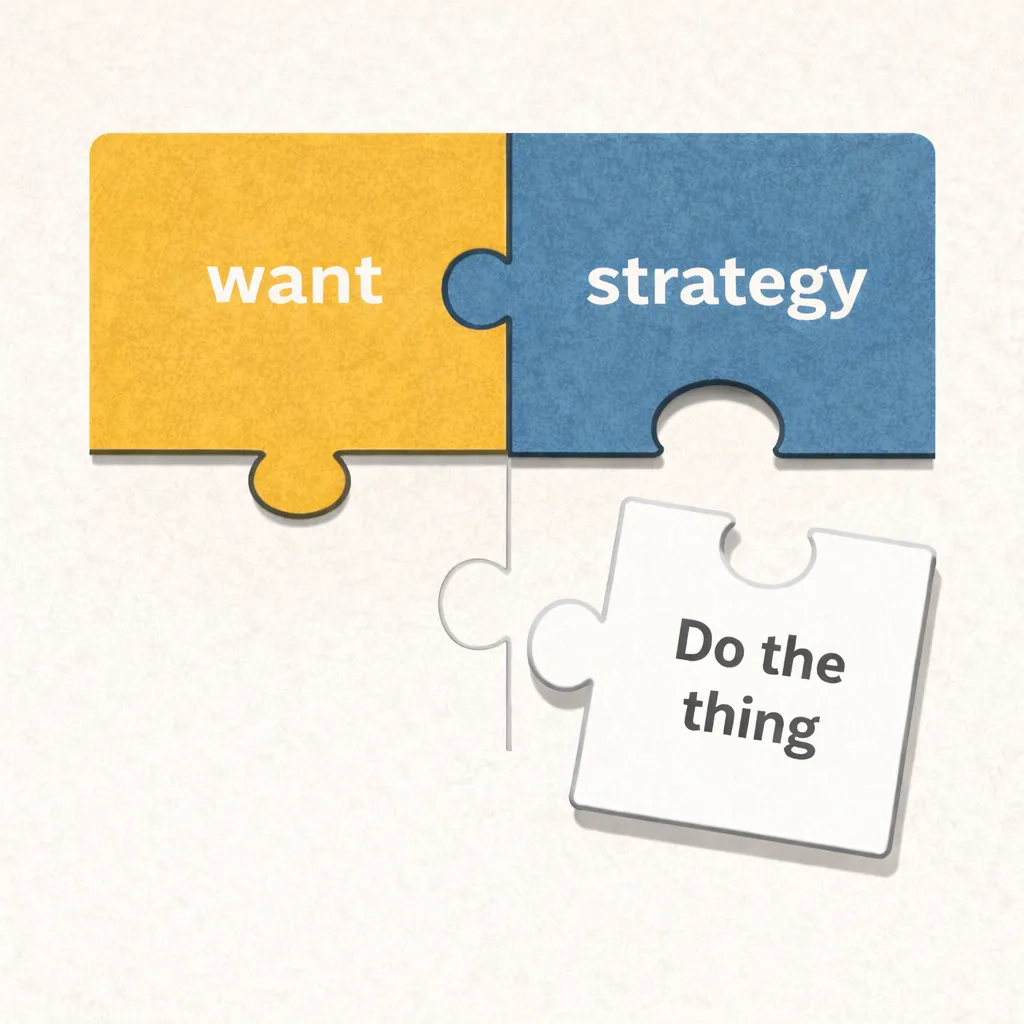
Over the past months I’ve come to realize that much of my process with my clients is this three step plan:

  1. Figure out what you really want
  2. Decide on a strategy of how to get it
  3. Work on that

That’s it. That’s the whole thing.

Step 1: Figuring out what you want

This could be anything. For a person, this is where they want to go in life. It could be a promotion, a raise, a new house, moving to a new location, anything. Many people are reactive, they just chase whatever opportunity is in front of them rather than setting a course for what they really want.

Continue reading “3-Step Process to Success”

Monkey and the Pedastal

I came across this piece of wisdom in Annie Duke’s book Quit, and I love it.

The concept also shows up in Google X—the division responsible for tackling the company’s most audacious bets. Self-driving cars. Internet balloons. Robotics.

At X, they use a mental model to prioritize work:

If your goal is to get a monkey to recite Shakespeare while standing on a pedestal…
You don’t start by building the pedestal.

Why?
Because building a pedestal is easy. Training a monkey to speak? That’s the hard part—and also the part that determines whether the whole idea is viable.

Their rule: Train the monkey first.

Continue reading “Monkey and the Pedastal”

Travis Kalanick’s Fundraising Tips

Back in 2005-2013, I was close with Uber founder Travis Kalanick.

Before he started Uber, he was Founder/CEO of RedSwoosh which was an interesting P2P software provider for content companies. RedSwoosh was eventually acquired by Akamai and Travis made a bit of money.

At that time he worked as an advisor helping companies get off the ground and raise money (see CrowdFlower, Honestly, etc.). He then went on to be an epic fundraiser himself with Uber and CloudKitchens. I wanted to share some of his tips as he was an expert at the art of negotiating and raising money. This list is his tips for success that he initially blogged at Swooshing.com (his old blog). At the bottom there’s a great video of him talking about working with seed stage startups and how to grow. It’s a great watch.

Continue reading “Travis Kalanick’s Fundraising Tips”

Willpower Isn’t Enough

I found this quick 4min video really interesting. It talks about how willpower isn’t enough to accomplish change. Similarly, neither giving someone an explanation of what’s wrong.

To truly get change, you have to have an insight. A new thought. That “aha” moment is what really drives change.

Here’s the link to the video

Changing Identity to Achieve Goals

I just read the book Atomic Habits and really enjoyed it.  Specifically, there was one part that really called out to me and it was about how to accomplish your goals.

As the author James Clear says, there are really mainly 3 ways to change

  1. Change your outcomes. Set new goals
  2. Change your processes. Set new habits, new activities, new meetings
  3. Change your identity or your beliefs.  Set new thoughts or perspectives
Continue reading “Changing Identity to Achieve Goals”

Getting Rid of Scars

We all have things in our past that we frequently remember, good and bad.  Some bad memories in my past are events where I’m really embarrassed about my behavior:  women I treated poorly, friends I didn’t respect as much as a should, and situations that I let get out of hand to a place where I was uncomfortable.  I would do all of them differently now but it’s obviously too late to fix.  These events pop up all the time in my head. I relive them, briefly, but regularly.

Imagine a river flowing.  This river is my energy as a person. Now imagine a rock in that river.  The water moves to go around the rock. It still flows and isn’t blocked much but the flow is somewhat disrupted.  Each one of these memories is one of those rocks. These are memories that get me charged up and that charge takes away from me doing other positive things and having positive thoughts.

This past weekend, I undertook an exercise to get rid of those rocks.

Continue reading “Getting Rid of Scars”