
This came from a post from The Athletic that has been deleted but I wanted to re-post it. At first glance, this is about an 18-year-old plan for a basketball practice by the legendary Coach K. But really, it’s about leadership and the many things that go into it: organization, delegation, adaptability and standards.
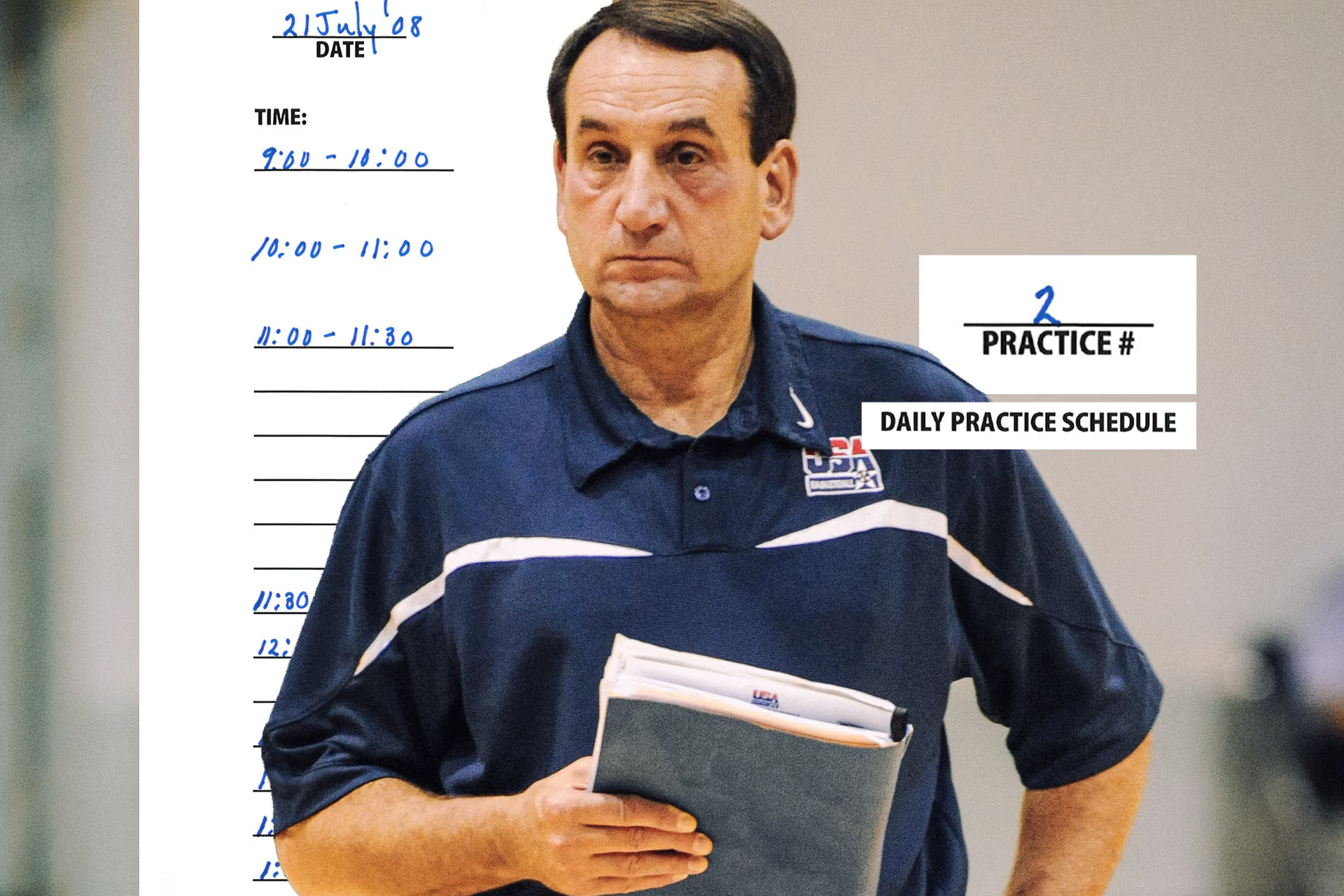
Coach K (real name: Mike Krzyzewski), is one of the most successful coaches in history:
- 1,202 wins, the most of any men’s college basketball coach
- Five national championships
- Three Olympic gold medals as head coach of Team USA
Krzyzewski is retired from Duke and has stated to TheAthletic, that he doesn’t miss the games. But he does miss the preparation, saying, “I do miss developing a practice plan.”
Here’s the plan we’re reviewing today.
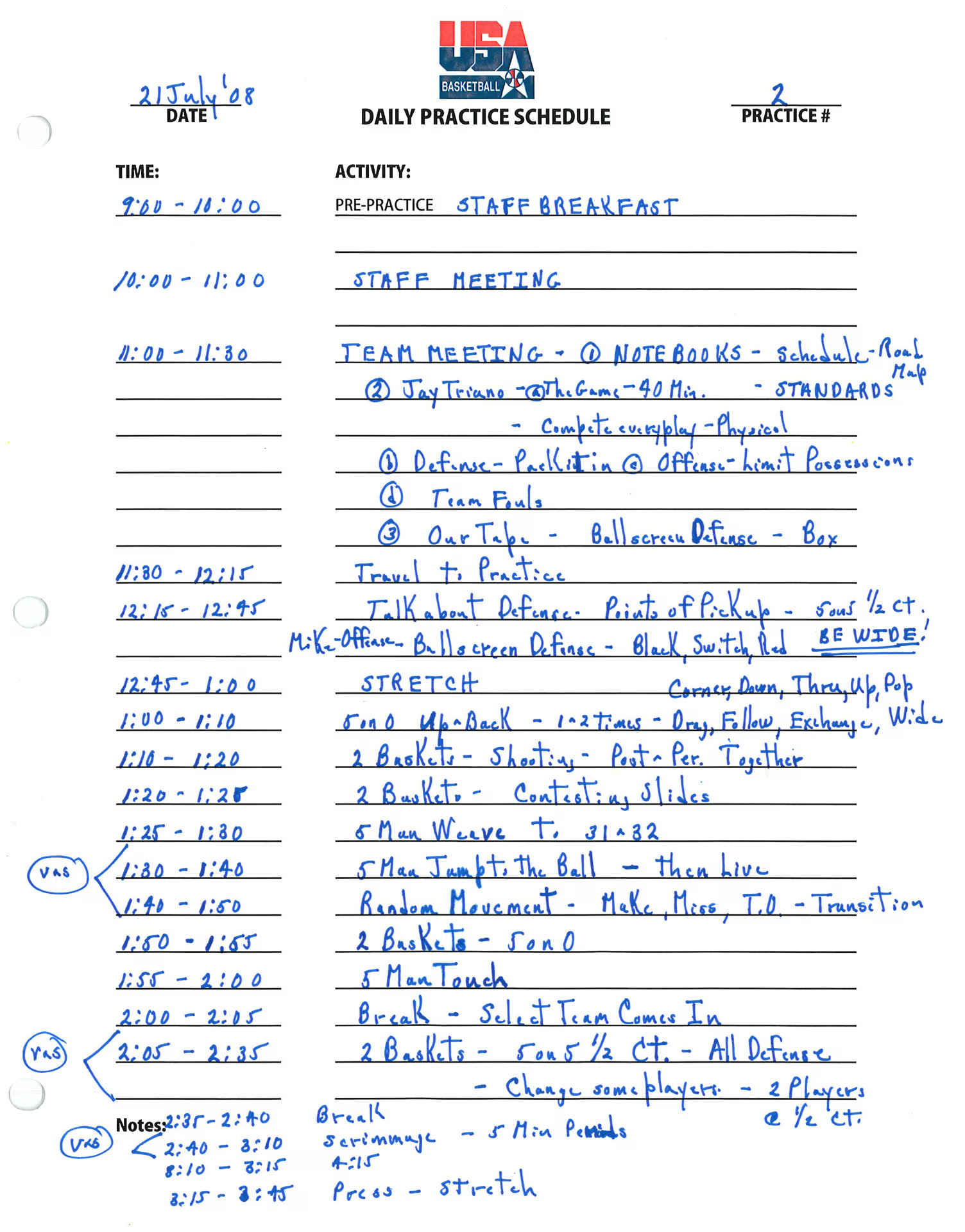
Before I get out of the way and let Krzyzewski explain his thinking, I wanted to start with one of the more interesting points he made: He said he never tried to script a practice plan based on what had worked for a team in the past. Every team, he said, evolves differently. The job of the head coach is to constantly gauge the mood and the pulse, and build a practice plan that fits that particular team’s moment.
“You have to stay current in the mood and where your team is physically, emotionally and mentally in your practice session,” he said. “By how you teach that day, you might have to change a mood. Or keep a mood going. Or get over a loss. Or get over a win. How you teach it, how you’re doing it, is based on where that team is at that point and what that team needs.”
In other words: He was never rigid with his practice plans (or his leadership). They were living, breathing things each and every day.
The Executive Team Meeting

Coach K: The staff meeting is to go through the practice plan. Somebody might say: “We should spend more time on this.” Or: “I don’t know if we’ll have enough time to do all of that.” I’d make adjustments based on that.
As a staff, we have to do that practice as one. Not as the head coach. The staff has to be one, including the helpers.
In other words, in conducting the drill, (assistant coaches) want to do it in a way that they can do it the very best and how they’re comfortable doing it. You are constantly customizing the practice plan to suit the staff and the team and where you think the team is at at that moment.
Setting the Culture / Setting the Standards

Coach K on notebooks: I wanted (players) to take notes. I’m a note-taker. Sometimes when you hear something and you write it down, then you can refer back to it.
Coach K on standards: We would have already had a standards meeting for how we were going to live together. That group had 15 standards. At that team meeting, I might emphasize two or three:
- “Remember today, we said we’re never going to have a bad practice.”
- “Remember today, we said we’re going to show strong faces.”
- The standards are habitual. You do it by repetition. You can’t just say we’re going to be enthusiastic one time.
Each day, you might say a couple of standards: “We have international officials in today. Remember, our goal is no complaining. Nothing to an official.” You might even tell an official to call a bad call, just to see how a player would respond.
They have to be done over and over again, just like your shooting drills, your plays, your defensive stance.
Facilitate the Meeting, Don’t Dominate

Coach K: The main thing is discussion: “Kobe, when I say ‘be wide,’ what do you think in that respect?” “When I say this, LeBron, what do you think?”
In getting them to talk about it, a lot of times I learned a different language. Not cussing or anything; I already knew that. But how they communicated.
A big thing that I learned right away was on defense. I said: “On the ball screen, we’re going to step in.” Jason Kidd said: “Coach, we have three different coverages. We have black, we have red, we can ice it.” They taught me one-syllable words that took the place of sentences.
The thing is, you learn from one another.
Your Team is Everything. Help Your Staff Grow

Coach K: I think for this I said to my assistants, “Chris Collins and Steve Wojciechowski, you have the shooting drills.”
My thought there was to give them an opportunity to prepare the shooting drills, but then, for me, I could observe. We had a good enough relationship that if there was a point in observing that I saw something, I could make a point even though they were doing the drill.
Your staff gets better from doing it, and they develop relationships with players that can be different than the head coach’s relationship with players and can make them better.
For your team to grow, your staff needs to grow throughout the year. They won’t grow unless you give them an opportunity to show what they can do. Your players don’t only make you better. Your staff makes you better.
Practice How You Play

Coach K on five-minute periods: Because that’s the length of TV timeouts. Even how you do it conditioning-wise, can you play five straight minutes strong? Get a one-minute break, and can you come back and do it? Or do we sub at that point? Do we put in one new guy?
The thing I tried to do all the time with my practices was make them game-like. How do you make them game-like? You don’t make them game-like by talking all the time and critiquing every play. That doesn’t mean you never critique a play. But you try to get continuous action so during that scrimmage it’s continuous five-minute periods.
Are You Doing Well? Ask the Team
So how did Krzyzewski evaluate a practice when it was over? He would consider:
- Did you have everyone involved?
- Did they give their best with enthusiasm?
- What did you accomplish?
The final thing he would do: At the end of practice, players would break out for individual work around the court. That was his time to get a feel for the mood of the team, which informed the next day’s practice plan. “I’d go up to Carmelo Anthony and ask: ‘What did you think about the two plays we put in today?’” Krzyzewski told me. “Or I’d go up to Chris Paul: ‘Did you feel comfortable?’ It gave me a chance for relationship building. And instead of having a meeting with a guy or guessing about how they feel, why don’t you ask a few of them how they feel?”